Last week was a heavy week.
The kind where everything feels harder than it should. Where doubt gets louder. Where old versions of you start knocking at the door, asking whether you’d like to come back to something more familiar.
I know that woman well.
She expects the worst. She searches for what’s missing. She believes she must work everything out alone because relying on anybody else has never felt entirely safe.
She uses fear, scarcity and control to protect me.
For a few days, I wondered whether I was becoming her again.
Then I realised, I’m not.
She had simply come back to see whether I still needed her. And for the first time, I didn’t let her take over. I opened up to my husband. I allowed myself to be supported by the women around me. I stood in the uncertainty without immediately trying to escape it.
And I thanked her for coming. She was only trying to keep me safe in the only way she knew how, but I lovingly closed the door.
She survived every day that brought me here. I will always be grateful for her. She got me here, but she doesn’t need to lead me anymore.
And once the heaviness began to lift, I realised I had been standing at another door too.
One I’ve been knocking on for years.
The door marked: THE SOLUTION.
I Have Spent A Long Time Searching For The Thing That Will Explain Everything
The right qualification. The right practice. The right book. The right person. The right belief. The right business strategy. The right way of understanding myself.
Counselling gave me one language. Coaching gave me another.
Reiki offered something different. Astrology helped me see patterns from another angle.
Neuroscience gave me language for the brain, beliefs, attention and behaviour. Nervous-system work helped me understand why knowing something intellectually doesn’t always make it feel safe inside the body.
Each time I discovered a new way of seeing myself, something opened.
And each time, part of me wondered: Is this it? Is this the answer?
I don’t think I’m alone in that.
We live in a world filled with people promising to show us the way.
Follow this morning routine and you’ll change your life in 21 days.
Regulate your nervous system, change your beliefs and heal your trauma then, hey presto, you’re fixed.
Find your purpose, think positively and raise your frequency, and everything will fall into place.
Build better habits, surrender but also take action and you’ll be living the life of your dreams next week.
Every doorway seems to come with somebody standing beside it, vigorously pointing at it and telling us that this is the one we need.
But I’ve started to wonder whether I’ve been asking the wrong question.
What if there isn’t one door?
There Are Too Many Ways To Be Human
There are too many histories, bodies, brains, cultures, relationships, losses, beliefs and experiences for there to be one way of understanding a human life.
One woman may understand herself through therapy. Another through faith.
Another through neuroscience, spirituality, creativity, movement, motherhood, philosophy, community or time spent alone.
One woman may find EFT transformational. Another may feel nothing at all.
One woman may feel deeply connected to herself during meditation, while another may find that sitting still makes her feel more uncomfortable.
Someone else may find clarity while running, writing, praying, travelling, painting or lifting weights.
Our needs can change across different seasons of the same life, so there really is no one-size-fits-all.
There isn’t a solution. There’s only what works for you.
And that may change at the rate of the British weather. And that. Is. Ok.
There have been practices that supported me for years and then stopped feeling right. Things I once dismissed have later found me at exactly the right moment.
I tried reformer Pilates and expected to love it. I didn’t.
That doesn’t make reformer Pilates ineffective. It simply means it wasn’t my answer. And that distinction matters.
Because when something helps another woman but doesn’t help us, we often assume we are doing it incorrectly. We decide we aren’t committed enough, healed enough, spiritual enough or disciplined enough.
But what if it simply isn’t our door?
I Don’t Want To Give You My Answer
I’ve realised something about myself too.
Whenever I discover something that helps me, I immediately want to share it.
There is love in that. Excitement too. The relief of finding language for something I’ve felt but couldn’t previously explain, but my answer cannot automatically become your instruction.
I can tell you what helped me. I can introduce you to a woman whose work made me think. I can explore the research, ask questions and show you the different ways people understand the same human experience. But I don’t want Becoming Her to become another voice telling women what they should believe or which door they need to walk through.
Because the moment I decide that my answer must also be yours, I remove something important: Your agency.
You are allowed to hear an idea and find it fascinating without adopting it as your truth.
You are allowed to try something and decide it isn’t for you.
You are allowed to change your mind.
You are allowed to be deeply interested in spirituality and still ask for evidence.
You are allowed to value science while recognising that science does not yet have language for every part of human experience.
You are allowed to take what helps and leave what doesn’t.
No elaborate justification required.
So I’m Changing How I Explore
Instead of trying to build one enormous framework that explains how women become who they are, I want to follow the individual threads.
What does neuroscience tell us about belief?
What does psychology tell us about identity?
What happens inside the nervous system when change feels unsafe?
How does language affect the way we understand ourselves?
What does grief alter?
What does motherhood reveal?
How do our relationships, clothes, homes, workplaces and communities influence who we believe we’re allowed to become?
What does spirituality offer that science may not?
Where do different ways of understanding overlap?
Where do they disagree?
And what happens when we place them beside one another without demanding that one of them wins?
I want to speak to the researchers, practitioners, founders, doctors, psychologists, artists and women who have lived these questions.
But I don’t only want the polished conclusion.
I want to know what happened before anyone could see the outcome.
Show Me The Woman Before The Breakthrough
Show me the woman before she built the business.
Before she wrote the book, created the method, or before she became the person other women now look towards for answers.
Who was she before? What happened? What did it make her question? What did she try? What did she reject? What did she choose? And who did she become because of it?
I don’t want five tips extracted from the life she created.
I want to understand the transition that created her.
Because her life is not an instruction manual. It is evidence.
I think about Melanie Perkins, co-founder of Canva. Today, we see Canva. We see the global company, the scale, the success.
But there was a Melanie before any of that existed.
She spent years trying to convince investors of an idea she could already see, collecting rejection after rejection along the way. She has spoken about returning to Australia from one fundraising trip feeling like a “complete and utter failure”.
And yet the idea she could see still existed.
She was living in the gap between what she could imagine and what she could prove.
And then I think about Whitney Wolfe Herd.
Before Bumble, something else had ended.
After leaving Tinder, she found herself in an intensely public and painful period of her life. Bumble wasn’t sitting neatly on the other side waiting for her. Her initial idea for what came next was something different entirely.
She was living in the gap between what had ended and what she hadn’t imagined yet.
That’s the part I’m interested in. The woman before the outcome.
The woman who doesn’t yet have the reassuring retrospective story that makes every decision look inevitable.
Sometimes she can see exactly where she wants to go but has no evidence she’ll get there. Sometimes she only knows she can’t stay where she was.
Both are liminal spaces.
And neither woman’s eventual success means that if we just keep going for long enough, everything we want will work out.
That isn’t the point.
Their lives aren’t instructions. They’re evidence.
Evidence that there are periods of a woman’s life where nothing has necessarily gone wrong simply because nothing has resolved yet.
We so often meet remarkable women afterwards.
I want to meet them there.
Evidence that another way exists.
Evidence that a woman can change her mind, leave an identity, question the rules she inherited and create something that didn’t exist before.
Evidence that there are doors we may not have noticed yet.
Evidence, not instructions
That may be one of the clearest ways I can explain what Becoming Her is becoming.
Evidence, not instructions.
Not one woman standing at the front of the room with the answer.
A room filled with women who have walked through different doors.
Women who changed careers, who left relationships, religions, communities or inherited expectations.
Women who rebuilt their lives after grief, illness, motherhood, failure or success.
Women who chose conventional lives consciously.
Women who chose unconventional ones.
Women whose work gives us a new way to understand the brain, body, identity, language, money, relationships, ageing, ambition, purpose or change.
Not so that we can copy them, but so that we can see what is possible.
Their lives can offer evidence without becoming instructions and their choices can expand ours without prescribing them.
I want an extraordinary life
I do.
And I don’t mean extraordinary in the Instagram version of the word.
I don’t mean that every day needs to be exciting, expensive or impressive.
I mean I don’t want to sleepwalk through my own life.
Look around you.
How many people do you know who are genuinely happy with the lives they’re living?
Maybe it’s someone you work with who has spent ten years telling you how much they hate their job but goes back every Monday.
Maybe it’s the couple who stopped being happy together years ago but have become so accustomed to being unhappy that leaving feels more frightening than staying.
Maybe it’s your mum or dad, who followed the path they thought they were supposed to follow and somewhere along the way stopped asking whether they actually wanted it.
Maybe it’s your friend who says, “This is just what life’s like, isn’t it?”
Maybe it’s you?
And I ask that lovingly.
Because I don’t think most people consciously choose a life that makes them miserable. I think it happens quietly.
We adapt, we tolerate, we repeat. We stay in the job because the salary is safe. We stay in the relationship because we’ve already invested fifteen years. We stay in the friendship because we’ve known each other since school. We keep playing the role our family understands because becoming someone different might make everybody uncomfortable.
And slowly, something that was supposed to be temporary becomes Tuesday.
Then another Tuesday.
Then ten years.
That’s what I don’t want.
I’m not even close to living a miserable life. I have so much that I love.
But I know, somewhere very deeply, that I don’t want to reach the end of my life and realise I kept choosing what was familiar simply because it was familiar.
I want to be awake for my life.
I want to choose it.
I want an extraordinary one.
I want to experience places I haven’t seen yet. Sit in rooms that once felt impossibly far away and have conversations that change something within me. I want to write, travel, create and keep following the questions that refuse to leave me alone.
I want Becoming Her to become bigger than anything I can currently see.
And I don’t want to pretend otherwise in an attempt to appear humble, sensible or realistic.
But I am beginning to understand that I won’t create that life by finding somebody else’s perfect formula and following it correctly enough. Absolutely, I can learn from other women, I can borrow courage from their stories, study what they built and listen to what they discovered.
But eventually, I have to choose.
Not from fear. Not because one door is the loudest, most popular or most convincingly marketed, but because I understand myself well enough to recognise what belongs to me and most importantly, what doesn’t.
The progression I’m beginning to see
First, understanding.
Who have I become? What shaped her? Which beliefs, roles and survival responses have been influencing the way she lives?
Then, liminality.
The space between recognising what no longer fits and knowing what comes next.
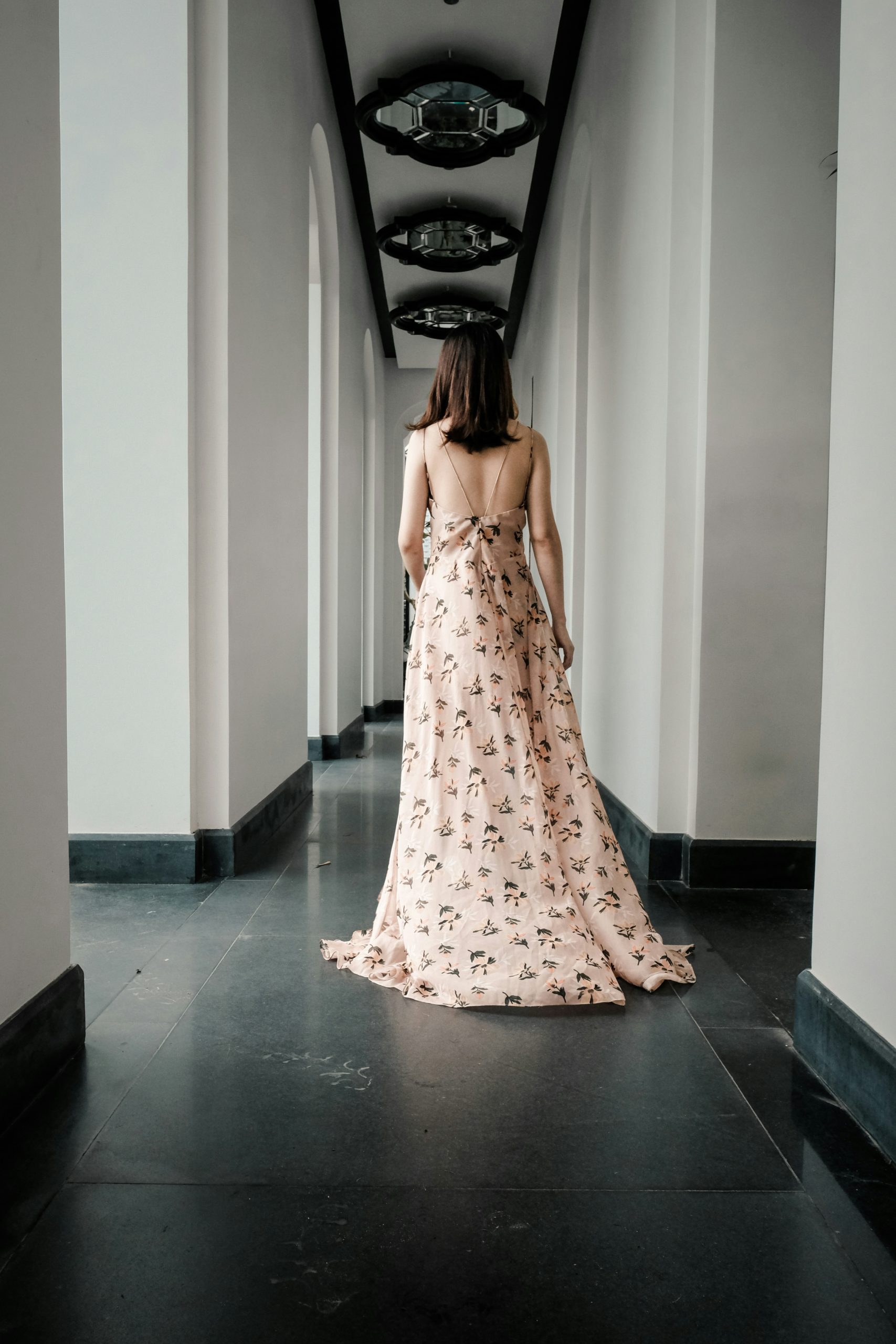
The hallway. The uncertain middle. The place where it can feel tempting to run back to the door we already know.
Then, choice.
Not a choice made because somebody else has promised us certainty. A conscious choice informed by what we now understand about ourselves and the possibilities we have allowed ourselves to see.
And then, embodiment.
Living the choice.
Allowing it to move beyond an idea and into our relationships, routines, clothes, work, environment, money, boundaries and everyday decisions.
Understanding. Liminality. Choice. Embodiment.
Not a rigid formula.
A rhythm I keep recognising in the lives of women who have consciously changed and possibly the foundation of everything Becoming Her is here to explore.
Maybe the answer was never waiting behind one perfect door. The point was always to enter a room filled with them.
To understand why we’re standing in the hallway. To see the doors that exist. To meet women who have walked through different ones. To gather evidence, language and possibility. To stay with ourselves while we decide.
And then to choose.
Becoming isn’t about never meeting our old selves again. it’s recognising her when she reappears and knowing ourselves well enough to choose differently this time.
It isn’t about finding the woman with the answer.
It’s about becoming the woman who trusts herself enough to choose.
With warmth,
Becky
Founder & Editor, Becoming Her
CONTINUE THE CONVERSATION
The Becoming Journal
If this chapter has left you thinking about the woman you’ve become, what has shaped her, and what you might consciously choose next, The Becoming Journal gives you somewhere to continue that conversation.
A guided conversation with the woman you’ve always been becoming.
£33. Instant Download. Explore The Becoming Journal