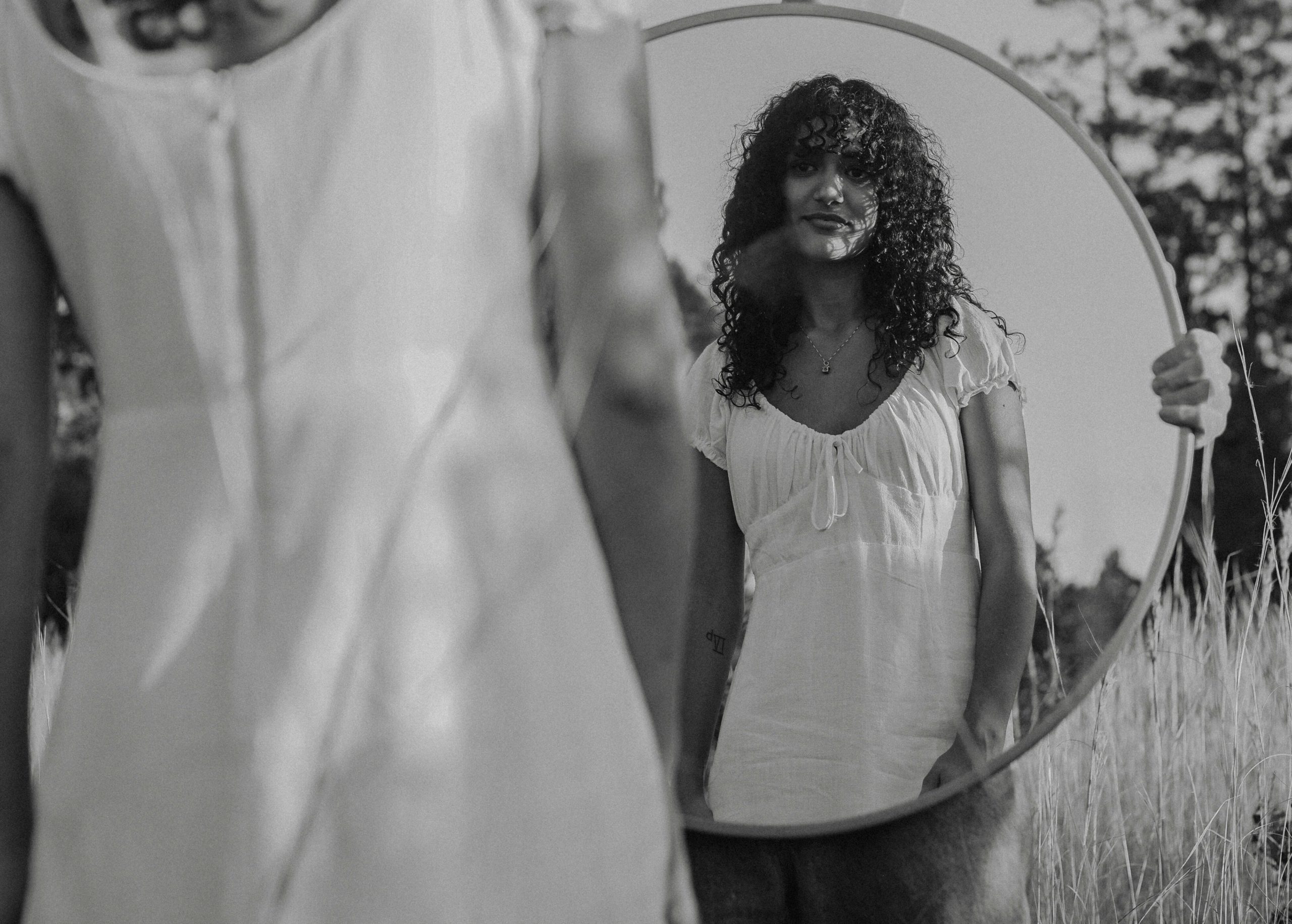
What our clothes reveal about bodies, identity and the women we’re becoming.
Women’s bodies change.
This is hardly groundbreaking information.
They expand. Contract. Carry babies. Recover. Age. Bloat. Scar. Heal. Respond to hormones, illness, stress, medication, menopause and simply being alive.
And while all of that is happening physically, we’re changing in ways that can’t be measured with a tape measure at all.
We become mothers, we leave relationships, we lose people. We change careers, we grow in confidence, we outgrow places and we stop wanting lives we once worked incredibly hard to create.
Sometimes nothing particularly dramatic happens. We just change.
Yet somewhere amongst all of this movement exists the rather peculiar expectation that our bodies, and the wardrobes built around them, should remain relatively consistent.
We change. But our clothes aren’t necessarily designed to change with us. And perhaps more interestingly: sometimes our clothes still fit perfectly and we’ve simply stopped wanting to be the woman who chose them.
I’ve been thinking about that a lot this week and, as often happens when something catches my attention, I fell down a bit of a rabbit hole.
Not so much into fashion itself, but into what happens when clothing meets transition.
Who’s questioning the expectation that women’s bodies should remain the same?
Who’s designing for the body that exists now rather than the one we’re encouraged to get back to?
And what happens when there is absolutely nothing ‘wrong’ with the clothes, or the body wearing them, but the woman herself has changed?
Because the more I’ve looked, the more I’ve realised this isn’t really a conversation about clothes at all. It’s a conversation about clothing and identity, and how we stay with ourselves while we’re changing.
The Body We’re Expected To Keep
Women’s bodies have always attracted commentary.
She’s put weight on. She’s lost too much.
She looks amazing for having had a baby. She’s let herself go.
She’s too thin now. She looked better before.
There seems to be a remarkably narrow window in which a woman’s body can simply exist without somebody having an opinion about it.
Eventually, some of those opinions become our own.
The jeans don’t fasten anymore and it isn’t simply: these jeans don’t fit my body. It becomes: my body doesn’t fit these jeans.
That’s a subtle distinction, but an important one.
Because one makes the clothes the thing that no longer fits and the other makes us the problem.
So we keep the jeans. For when we lose the weight. For when our body settles down. For when the bloating stops. For when we get back to ourselves.
Except women’s bodies aren’t static.
Research reported by The Guardian earlier this year suggested the average British woman may change dress size more than 30 times during adulthood, moving up and down as our bodies respond to hormones, pregnancy, ageing, lifestyle and simply being alive.
Thirty times.
Not thirty different sizes. Thirty shifts between them.
Which makes me wonder why we’ve built such an enormous culture around women trying to maintain bodies that were never going to remain the same.
This was the first part of my rabbit hole.
Because sometimes we haven’t changed dramatically at all. Our body is simply doing what bodies do; a few pounds either way, a bloated week, a menstrual cycle, pregnancy, postpartum, perimenopause or menopause. And suddenly the wardrobe we spent years building only works for one particular version of our body.
That’s what made me interested in The Female Archetypes.
Founder Alice Holland-Lu created the business following her own experience of motherhood, body change and a loss of identity. Rather than expecting a woman’s body to remain fixed, the brand creates garments designed to accommodate change, using adjustable elements that allow the clothes themselves to move with women through different sizes and stages of life.
And I love the reversal in that.
The woman isn’t being asked to fit the clothes. The clothes are being asked to fit the woman.
And there’s something about that which feels much bigger than fashion to me, because what would happen if, during periods of change, we weren’t always encouraged to immediately correct ourselves? What if we didn’t have to urgently get back?
Back to our old weight. Our old body. Our old routine. Our old confidence. Our old self.
What if some of the things around us simply made enough room for us to change?
Because there is a period in any transition where we don’t necessarily know where we’re going to land. Our bodies can be like that too.
Clothing that moves with us can offer something surprisingly important in that in-between: permission to stop rushing towards the body we think we’re supposed to have.
We can simply be where we are.
But Sometimes The Body Really Has Changed
Then my rabbit hole took me somewhere else.
Because there are changes that aren’t fluctuations.
Sometimes a woman experiences something that fundamentally changes her relationship with her body. Surgery. Illness. Treatment. Disability. A mastectomy. A stoma. Scarring. Recovery.
A body can become unfamiliar incredibly quickly.
And when that happens, clothing can become yet another reminder that much of the world was designed for the body she had before.
That’s how I discovered Weldun.
Its founder, Carly Berlin, created the adaptive-fashion marketplace following her own double mastectomy. During recovery she found that much of what was available to accommodate her changed body felt clinical and medical rather than resembling the fashion she’d worn before.
Weldun brings together design-led clothing for people navigating physical changes through experiences including surgery, illness, disability, pregnancy and ageing.
And this stopped me.
Because imagine already trying to understand yourself inside a body that suddenly feels unfamiliar and then discovering that the clothes available to you no longer look like you either.
There is something incredibly powerful about saying: you are allowed to need something different now without becoming someone less yourself.
That’s another way our environment can hold us through transition. Not by pretending nothing has changed, and not by demanding we immediately become comfortable with everything that has, but by meeting us where we are now, while we’re still working out what this change means.
To dress the body that is here. To meet the woman who is here. To allow the world around us to make room for the transition happening within us.
And Then There’s The Woman Whose Body Hasn’t Changed At All
But not every transition leaves a visible mark on the body.
You don’t need to have had a baby. You don’t need to have gained weight. You don’t need to be navigating menopause, surgery or illness.
You can stand in front of the exact same wardrobe, in the exact same size-12 jeans you wore five years ago and they fasten and they fit. Objectively, there is nothing wrong with them, but you can think: I just don’t want to be her anymore.
Maybe you’ve changed careers, left a relationship, become a mother without personally experiencing pregnancy or birth. Maybe you’ve built confidence you didn’t have then, or you’ve stopped trying to disappear. Maybe the life those clothes belonged to simply doesn’t exist anymore.
There doesn’t even have to be a neat explanation. You put them on, look in the mirror, and know: this isn’t me.
That’s a very different transition.
The dress isn’t wrong. Your body isn’t wrong.
You don’t have to keep it simply because it once belonged to you.
What If Letting Go Is Part Of Becoming?
Which, strangely enough, led me to think about Vinted completely differently.
We mostly talk about resale platforms through sustainability and affordability. Buying second-hand, selling what we no longer wear and giving clothes another life.
But there’s another exchange happening there too. We’re releasing versions of ourselves.
The dress from the relationship that’s over. The blazer from the career we’ve left. The clothes bought for a body we’re no longer trying to return to. The heels belonging to a social life we’ve outgrown. The thing we bought because everyone else was wearing it.
And interestingly, Vinted itself has begun exploring similar territory. Its New Again platform is built around the idea of fresh starts and the freedom to reinvent ourselves repeatedly. When Alexa Chung sold pieces from her wardrobe through Vinted, she talked about doing so because her own style was evolving.
I find that fascinating, because perhaps clearing a wardrobe isn’t always about decluttering, sometimes it’s acknowledgement.
I loved her. I needed her. I was her. And I’m not trying to get back to her anymore.
The clothes can go somewhere else. Someone else can wear the dress. Someone else can make a memory in it. And the empty hanger isn’t necessarily loss.
It might be space.
Space to consciously choose what belongs to the woman you’re becoming.
Because Clothes Are Never Just Clothes
Think about what you reach for when you feel confident compared with what you wear when you want to disappear.
There are days when we want colour. Shape. Jewellery. Lipstick. Heels. There are others when we want the biggest jumper we own.
Sometimes we dress to be noticed, sometimes we dress not to be. Some days baggy clothes are simply comfortable and some days they’re armour.
Neither is inherently good or bad. But it’s information.
Our clothes can tell us something about how we’re experiencing ourselves. How comfortable we feel taking up space, how safe we feel being seen, how connected we feel to our bodies and whether we believe the body we have now deserves to be dressed beautifully, or whether we’re waiting for another one.
And they can tell us something else too. Who we think we’re allowed to become.
Because fashion will happily tell us what’s next; a new season, a new silhouette, a new colour, or a new shoe, and something we were encouraged to buy twelve months ago is suddenly declared dated.
But there is a difference between asking, “what’s fashionable now?” and asking, “what feels like me now?”
One asks us to look outside ourselves. The other requires us to know ourselves.
And if we’re in the middle of becoming someone new, we may not know the answer yet.
Maybe That’s What The Wardrobe Is Showing Us
The more I thought about these three very different responses to change, the more interested I became in what our clothes can reveal about the transitions we’re living through.
Because none of them is really answering the same problem.
Sometimes, my body is fluctuating. Can my clothes move with me?
Sometimes, my body has physically changed. Can fashion meet me where I am now?
And sometimes, I’ve changed. Can I let the old version of me go?
The Female Archetypes, Weldun and Vinted sit in very different parts of the fashion world. But viewed together, they made me think about something Becoming Her returns to again and again: what helps a woman stay with herself while she’s changing, and what helps her eventually choose what comes next?
That feels like the bigger conversation.
Not simply what should women wear? But how can the world around us make room for the woman we’re becoming?
Because becoming doesn’t only happen internally.
There is the moment we realise something no longer fits. The uncomfortable middle, when we don’t quite know what comes next, and eventually, there is the opportunity to choose.
To decide what stays, what goes, what moves with us and what begins to represent the woman we’re becoming.
Eventually, our external world begins to catch up with what’s been changing internally: our clothes, our homes, our relationships, our work, the rooms we enter and the people we surround ourselves with.
Embodiment can look like this too: allowing the life around us to begin reflecting the woman emerging within us.
So the next time you’re standing in front of a wardrobe full of clothes thinking you have nothing to wear, don’t rush immediately to buy something new.
Stay there for a moment. Look. Get curious.
Who was I when I chose this?
Am I keeping it because I love it, or because I’m still expecting myself to become her again?
And does the woman I’m becoming feel represented here?
You may discover your body has changed. You may discover your style has changed. You may discover nothing has changed except you.
None of those things mean you’ve got it ‘wrong’. Sometimes the wardrobe simply hasn’t caught up yet.
With warmth,
Becky
Founder & Editor, Becoming Her
Continue the conversation
If this chapter has made you curious about what else in your life may still belong to an earlier version of you, The Becoming Journal was created for exactly that conversation.
A guided space to understand the woman you’ve become, recognise what has been shaping your choices, and consciously consider what you want to carry forward and what you’re ready to leave behind.
Because you cannot consciously choose what comes next until you understand what has been choosing for you until now.
£33 Digital journal, Instant access