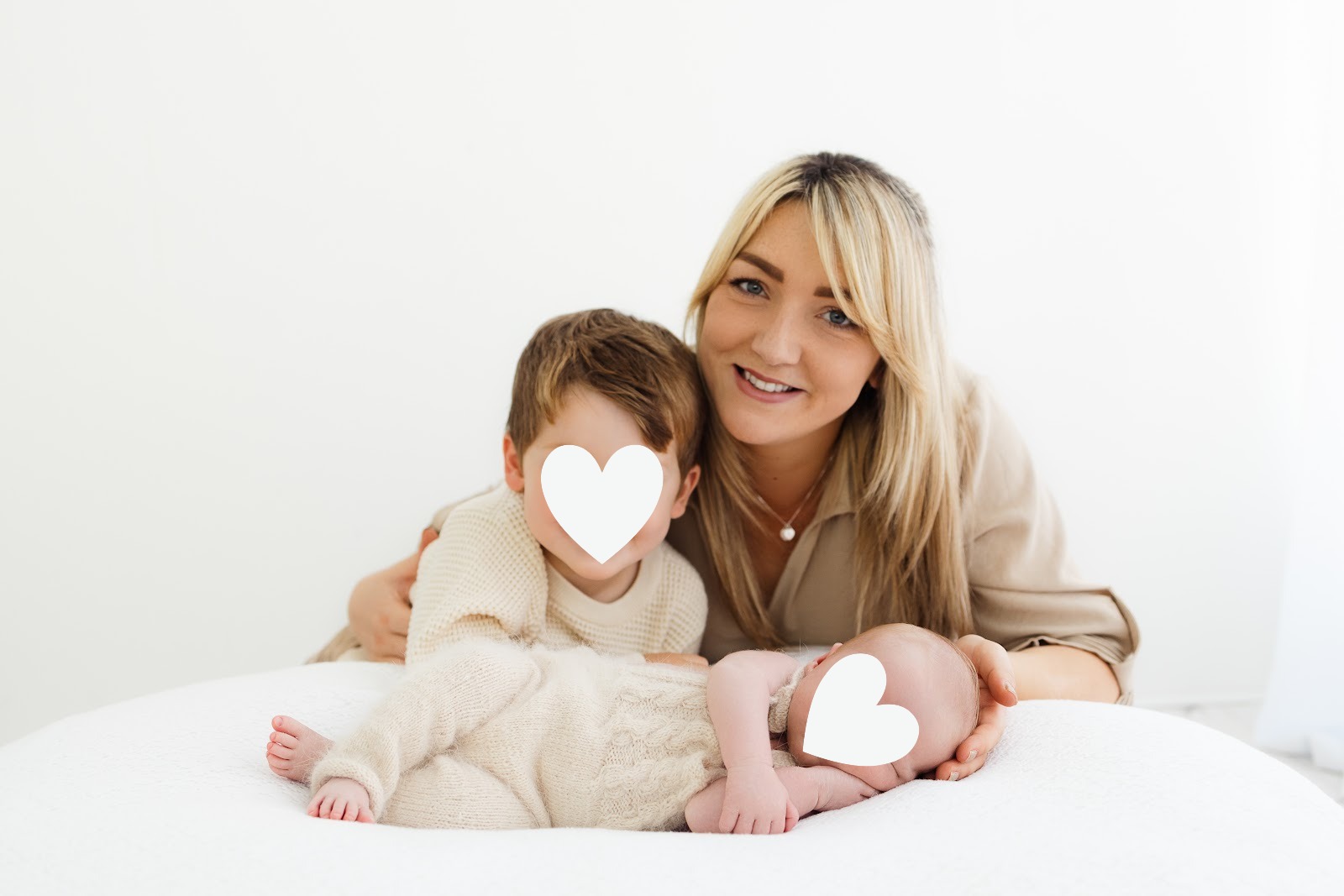
Everyone prepares you for giving birth, but nobody prepares you for becoming someone new.
You can read every book, listen to every podcast and attend every antenatal class. Your midwife will prepare you for the physical side of birth; the growing bump, the hospital bag, the birth plan (which, in my case, never saw light of day with either of my boys!), the breathing techniques, maybe the breastfeeding demonstration or how to make a bottle. You’ll learn about contractions, Braxton Hicks, nappies and newborn care.
And all of that matters. But nobody can truly prepare you for what happens to you. Not because they don’t want to, but because I honestly don’t think it’s possible.
How do you possibly explain what it feels like to suddenly become somebody’s entire world?
How do you prepare someone for the mental load and exhaustion of thinking ten steps ahead before you’ve even had your morning coffee, all while running on non-existent sleep?
How do you put into words the identity shift that quietly unfolds after your baby is born?
You can’t.
Because motherhood isn’t simply something you learn, it’s something you become. And until you’re living it, it’s almost impossible to comprehend the magnitude of the woman you’re in the process of becoming.
People often ask new mums how the baby is sleeping, how feeding is going or how much they weigh. A personal favourite of mine was ‘is he a good baby?’ (not entirely sure what they meant, but he didn’t sleep, cried all day and refused a bottle, so I assumed not!) But very few people ask the mother how she’s doing in this intense becoming phase.
Overnight, your entire life ceases to belong solely to you; your sleep, your body, your routines, your social life, your wardrobe, your conversations, thoughts and time.
Everything changes.
One day you’re deciding which ‘pre-drinks’ to take round to your friends house, or choosing what movie you want to see for your spontaneous date night, to next calculating whether the journey time aligns with nap schedules, whether you’ve packed enough snacks, spare clothes, wipes, Calpol, water bottles, muslins and approximately seventeen items required for every possible emergency known to mankind.
You don’t just birth a baby. You birth a project manager. A logistics coordinator. A nutritionist. A risk assessor. And most importantly, you birth an alarm clock.
Your day is no longer dictated by you. It’s dictated by a tiny human whose favourite hobby appears to be pooing five minutes before you’re due to leave the house.
Every. Single. Time.
Then there’s the invisible work; the mental load, the thinking ten steps ahead, constant awareness, being on alert, and never truly switching off. Because when you’re the default parent, even when your body sits down, part of your mind doesn’t.
You’re always listening, always anticipating, always preparing, always aware. And whilst there is immense love in that, there is also exhaustion. The kind of exhaustion that no amount of coffee can fix.
Nobody Talks About Matrescence
My first son was born during Covid. He had what doctors ‘diagnosed’ over the phone, as colic. One piece of advice I was given was to simply turn the car ignition on, because apparently that had worked with his own children.
I remember thinking, ‘surely there must be more to modern medicine than sitting in my parked Volkswagen?’
Then after my second son was born, another doctor completed my postnatal check. After examining my baby, he looked at me and asked, and ‘How are you?’ ‘Fine’, I replied, ‘just shattered’. Which apparently counted as a glowing review because moments later I’d officially been ‘discharged’.
Tick.
Thumbs up.
Off you go.
Now, this isn’t criticism, it’s perspective, as I have the most wonderful supportive husband who was the best team mate to have in the newborn trenches, but with the greatest respect in the world, unless you’ve physically experienced pregnancy, birth and postpartum, it’s almost impossible to fully comprehend what a woman’s body and brain have just been through.
Science now tells us that pregnancy physically reshapes the maternal brain.
Areas responsible for empathy, emotional processing, social connection and caregiving are remodelled during pregnancy and after birth, and researchers even have a name for this transformation; matrescence.
Much like adolescence, matrescence is a profound developmental stage. It isn’t simply about learning how to care for a baby. It’s about becoming a mother; biologically, emotionally, psychologically and identity-wise. In other words, after birth, we are literally not the same woman. And yet so many of us expect ourselves to be.
The Identity Shift Nobody Warns You About
For me, this was perhaps the biggest shock of all.
Your baby arrives overnight (well, not quite overnight in the case of my firstborn, but certainly with my second!), and in that very moment, life changes in an instant. You change in an instant. But understanding who you’ve become takes much longer.
Your body spent nine months gradually changing, then suddenly the baby is in your arms. The bump disappears and you’re left staring at a body that doesn’t quite feel familiar. A wardrobe chosen largely by what allows the easiest access for breastfeeding replaces the clothes that once reflected your style. Gone are the days of simply grabbing your handbag and keys. Now you leave the house carrying what feels more like a small carry-on suitcase, packed for every conceivable scenario.
And somewhere amongst the feeding schedules, washing piles and sleep deprivation, it’s easy to lose sight of the woman beneath the role.
Not because you don’t love your children. Quite the opposite. I would go to war for my boys without hesitation. A mother is a lioness, and her children are her cubs. The love is primal. Protective. Powerful. It’s unlike anything I have ever experienced.
… And perhaps that’s exactly why this conversation matters. Because acknowledging the enormity of motherhood isn’t complaining about motherhood. It’s honouring it. It’s recognising that your life has fundamentally changed, and so have you.
Motherhood isn’t simply a new role you’ve taken on. It’s the beginning of a new version of you.
Returning to Work… But Returning as Who?
Eventually, many of us return to work. But we don’t return as the same woman who left.
Our priorities have changed. Success can look different. Maybe we want less; less pressure, less climbing. Maybe we want more time, presence and energy for the people who matter the most. And that’s beautiful.
For others, motherhood awakens something; a drive, a purpose, a determination to create something meaningful. Not despite having children, but because of them.
Both infact were true for me. Motherhood didn’t make me less ambitious, it made me more intentional, more driven. I suddenly understood how precious time really was. I wanted more for my boys, more for my husband and more for our future.
But if I’m completely honest, I wanted more for me too. Not because what I already had wasn’t enough, but because I wasn’t finished becoming.
The Question We Should Be Asking
Perhaps the conversation isn’t whether motherhood changes us. It does.
It isn’t whether it’s hard or not. It is.
And it certainly isn’t whether we love our children. Of course we do.
The real question is; Who are we becoming through it all?
Because motherhood isn’t the end of your story, it’s one of the chapters that reshapes it. It asks you to meet yourself again. Not as the woman you were before, but as the woman you’re becoming.
And she might just surprise you.
With warmth,
Becky
Founder, Becoming Her
One response to “You Don’t Just Birth a Baby. You Birth a Whole New Version of Yourself.”
[…] Alice Holland-Lu created the business following her own experience of motherhood, body change and a loss of identity. Rather than expecting a woman’s body to remain fixed, the brand creates garments designed to […]